Food is the first medicine.
Why is food insecurity a healthcare issue?
Reliable access to food is a foundation of health. At EmblemHealth’s Nourishing Our Neighborhoods gala, Subbu Ramalingam reflects on how health plans, public programs, and community organizations can work together to address food insecurity in New York City.
I have been meaning to write about Monday night all week. A few days on, I am still a little full, and not just from dinner.
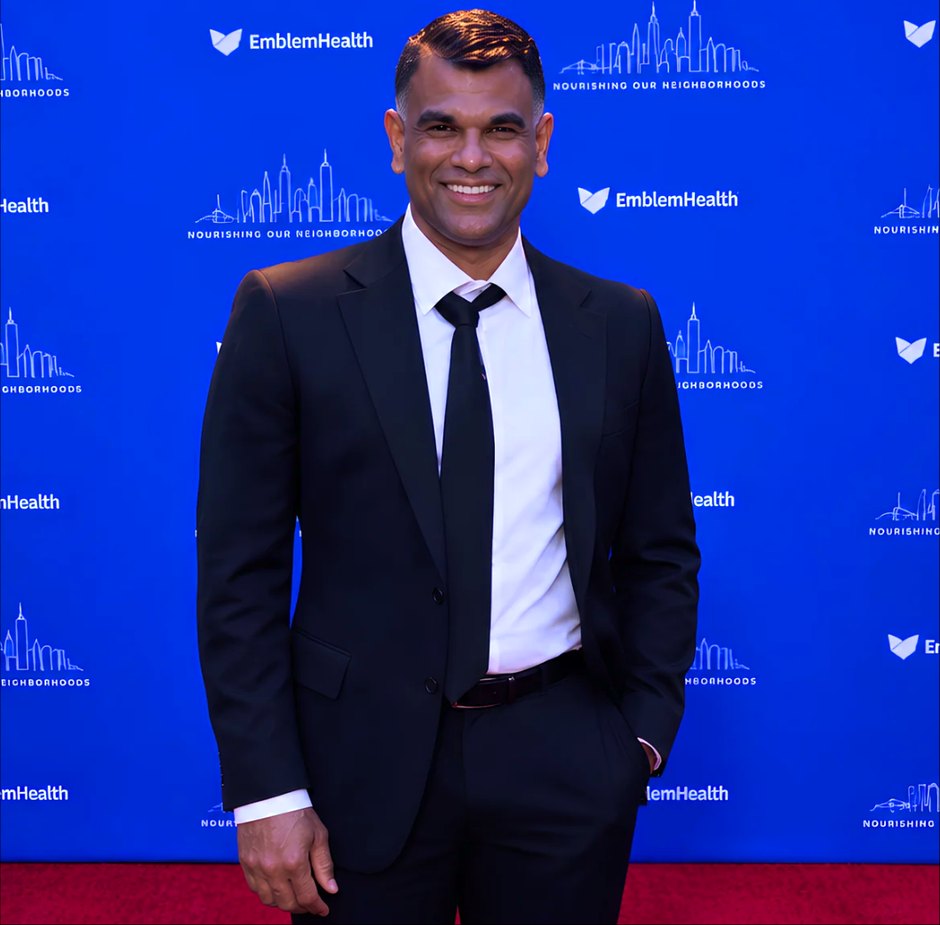
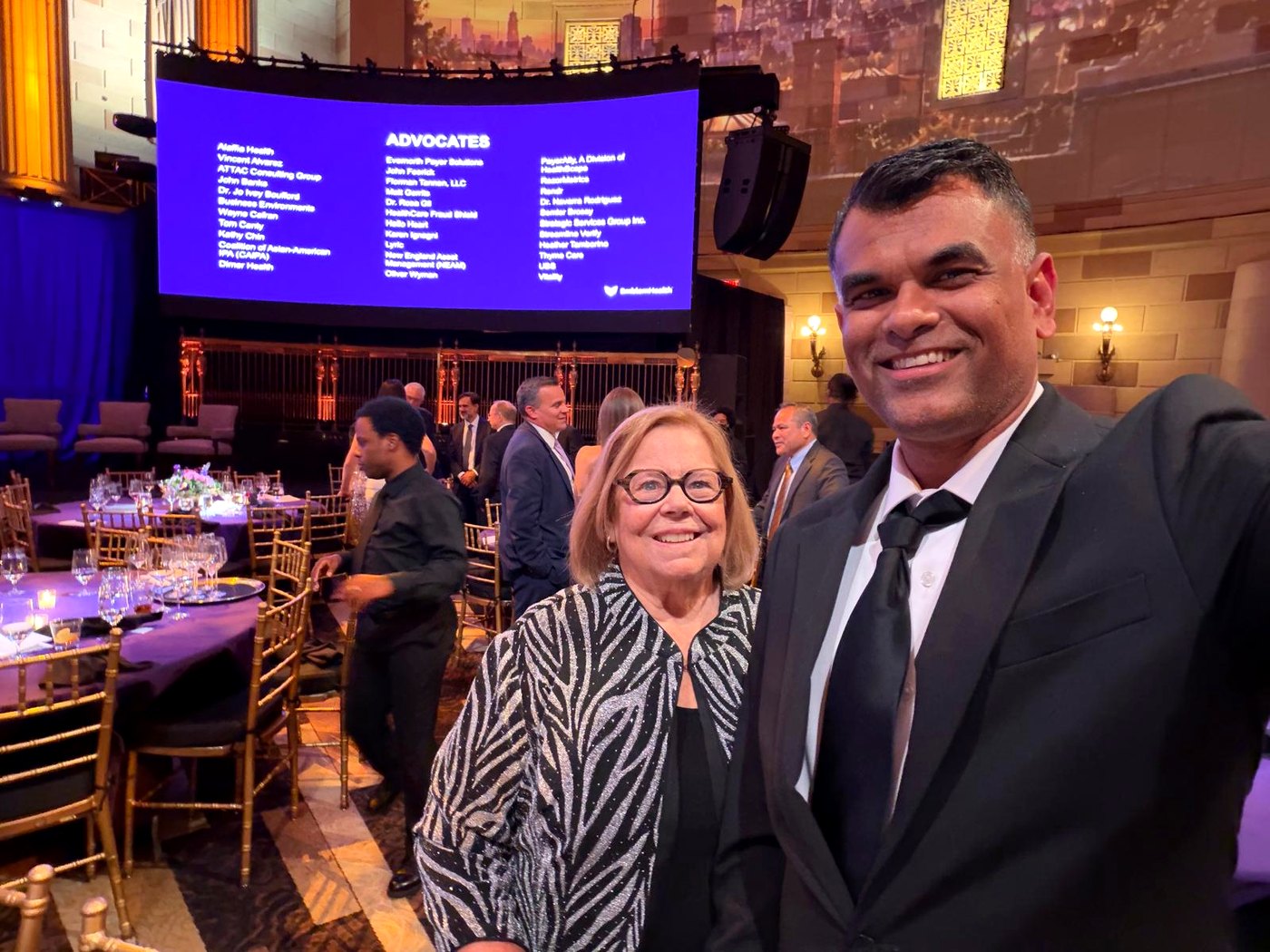
I was in New York for EmblemHealth's Nourishing Our Neighborhoods gala, there with my colleague Anne Crawford, representing ATTAC Consulting Group, which sponsored the evening as an Advocate. I am a Managing Director at ATTAC, and my own firm, Vivega Health, works as a subcontractor to ATTAC. EmblemHealth is a client of ours, so the night already carried weight. But my history there runs deeper. Before 2020, I was the Senior Director who managed the EmblemHealth relationship as a solutions provider, working to improve care and outcomes for their members. So walking into that room was not a networking stop. It felt like coming home.
It was billed as a gala, but it felt more like a giant family dinner that happened to have a thousand people at it. And everything that night kept coming back to one idea. Food is health.
The part I keep replaying
The heart of the night was a conversation on stage between Chef José Andrés and Melba Wilson, the two of them together, trading stories back and forth, and I could have listened all evening. If you have never heard José tell his own story, go find it. He took us back to Spain, to his mother's kitchen, where he learned early that cooking was never about showing off. It was about taking care of people. He came to New York with next to nothing, made his way to Washington, found DC Central Kitchen, and learned what it meant to cook for people who were hungry, not just for people who could pay.
Then he got to the disasters. The floods, the storms, showing up with a hot meal when everything else had fallen apart. That instinct grew into World Central Kitchen, which now feeds people in crisis zones around the world. And the whole time, he had the room laughing. Here is a man with three Michelin-rated restaurants, still telling the story of the soup, not the stars.
Melba matched him story for story, and the room changed. Where José brought humor, Melba brought fire. Harlem is her life. Her restaurant is Harlem. When she talks about feeding her neighbors, you get it right away: this is not charity, and it is not a business plan. It is love with a plate in its hand. Listening to the two of them go back and forth, they made the same point from opposite directions. A hot meal is how you tell somebody they matter.
And then the numbers hit
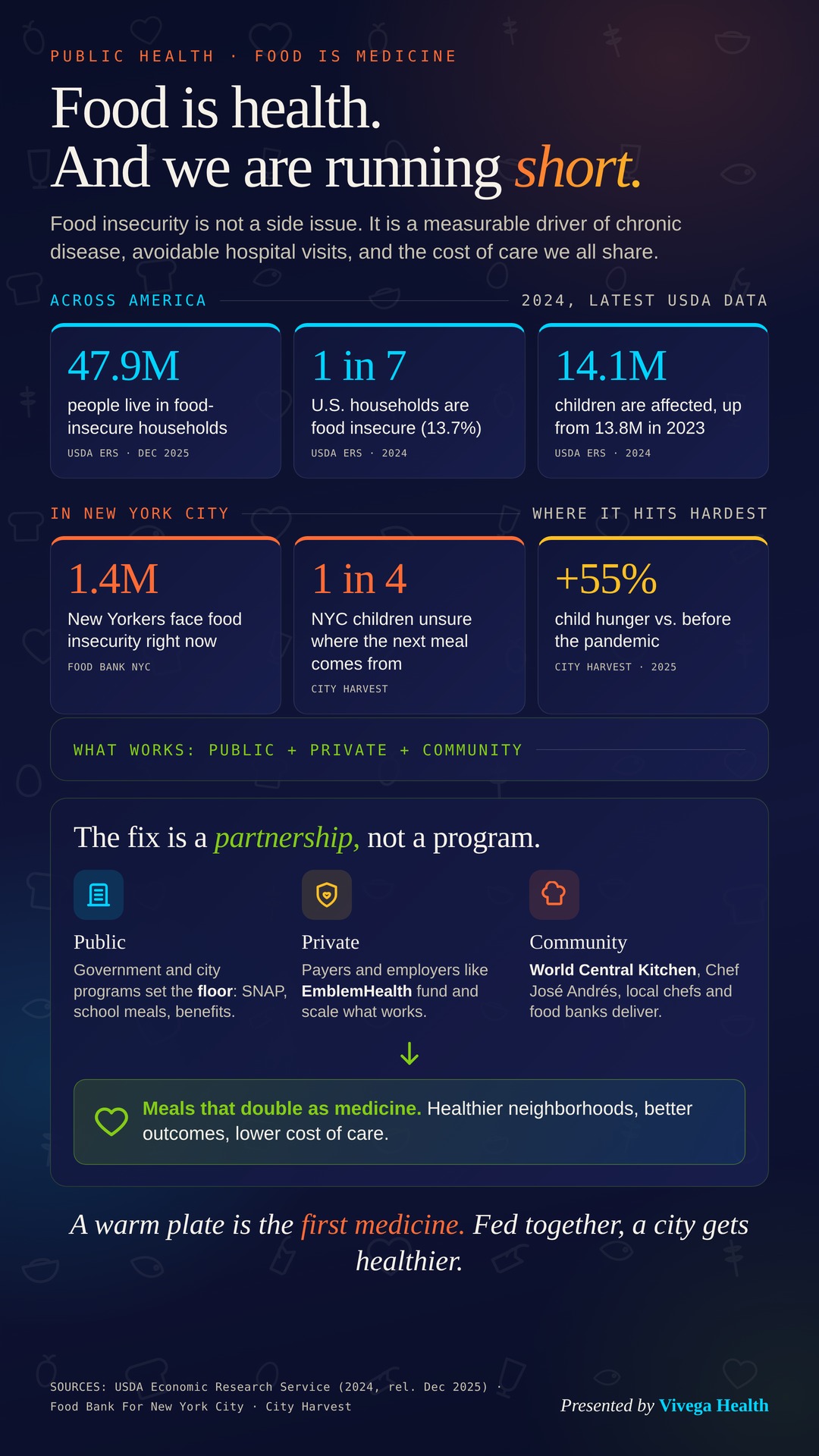
The numbers are hard to sit with. Recent estimates put roughly 1.4 million New York City residents at risk of food insecurity. City Harvest’s 2025 child hunger report says one in four NYC children does not always know where the next meal will come from. An earlier City Harvest comparison, reported in 2022, found child hunger about 55 percent higher than before the pandemic. Nationally, USDA’s 2024 report, released in December 2025, found that 47.9 million people lived in food-insecure households, including 14.1 million children. These figures describe different populations and reporting periods, not a single current snapshot.
This is not just a hunger gap. It is a health gap. And it does not stay quiet. It turns up later, in emergency rooms, in chronic disease, in Star Ratings, and in the cost of care we all share.
A plan that actually walks the talk
What got me, maybe more than the stats, was watching EmblemHealth put its conviction on the stage. Their CFO, Heather Tamborino, had a real conversation with people from her own team, the ones doing the work out in the boroughs, Staten Island, Manhattan, Queens, and Brooklyn. How often does a chief financial officer get up and talk about community investment as core to the business, not a line item to defend? Almost never. There was nothing soft about it. This is a plan putting real dollars into the neighborhoods it serves and calling that part of the job. I have spent my career in and around health plans, and that is rare, and it is serious.
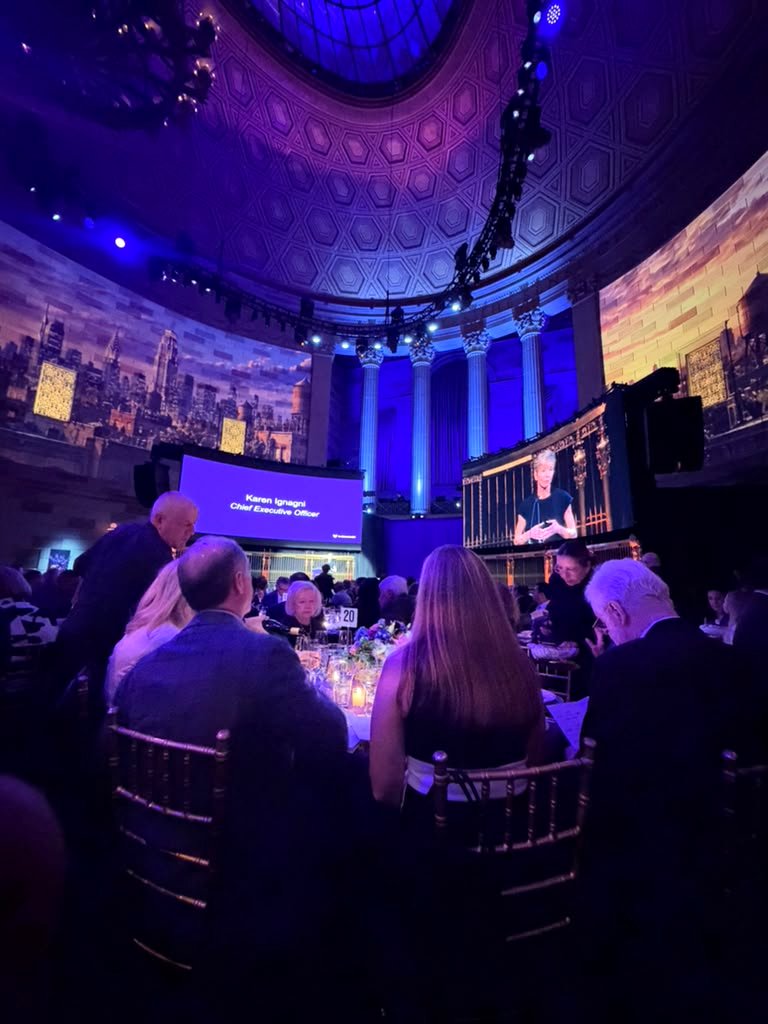
I also got real time with Karen Ignagni, EmblemHealth's CEO, a direct and generous conversation, and with a number of their other leaders. And I kept running into people from across the ecosystem, Cognizant, Accenture, Veradigm, Healthcare Partners IPA, and many of the other sponsors and supporters. ATTAC sponsored as an Advocate, and it meant something to stand alongside so many others there for something none of us can bill for.
And that is the lesson of the night. A problem this big does not get fixed by a program. It gets fixed by a partnership. Government and the city set the floor with SNAP and school meals. Payers and employers like EmblemHealth fund the work and scale what works. And community organizations do the delivering, the World Central Kitchens, the José Andréses, the Melba Wilsons, the food banks that know every block by name. Not one of them closes the gap alone. Together, they turn meals into medicine.
Why I do this
Nights like these make me realize the hard work that goes into getting out into neighborhoods and working in the community. I know that work well. I did it with my team at CareFirst in the Washington DC and Maryland area, and at Independence Blue Cross across the Philadelphia and New Jersey area, and I do it now through my nonprofit bringing health care to communities in India and Africa. My days are spent helping health plans and the companies around them turn good intentions into results you can measure: higher Stars, more accurate risk, and AI that works in the real work. Our industry pours enormous energy into measuring quality downstream, after the care, after the gap, after the complaint. The people in that room are betting on the front end instead. Feed the block, and a surprising amount of the rest, the adherence, the outcomes, the measures, starts to sort itself out.
That belief is exactly why Vivega Health exists. Our mission is to impact $1 billion in healthcare costs and improve the quality of care for 1 million lives by 2032, in the U.S. and globally, through services and solutions tailored to healthcare organizations. And our vision is a world where good healthcare does not have to cost more, no matter where you live, where the organizations that pay for and deliver care work together to close the gap between what care costs and how well it actually works, so everyone gets care that is well organized, affordable, and fair.
Food insecurity lives right inside that gap. It is one of the clearest places where cost and quality meet, where the difference between a good plan and a great one is whether its leaders see a neighborhood as a line of risk or as people worth feeding. Monday night, New York chose people. The work now is to keep choosing them after the lights go down.
Each link goes to the organization's own website, for donating, participating, or finding food assistance.
To the EmblemHealth team who made Monday night what it was, Karen Ignagni, Heather Tamborino, and Abdou Bah (SVP, Clinical Operations): thank you. And to the EmblemHealth leaders we have the privilege of working with throughout the year, John Barkley (VP, Risk Adjustment and Data Integrity) and Deborah Lighter (Chief Compliance Officer): thank you as well. To Chef José Andrés, Melba Wilson, and everyone who does this work every day, thank you. Count me in.